


Coming Fall 2016:
Under Siege!
13 year old Pedro has been told he is too young to fight. When the English attack the Castillo de San Marcos fort in the Spanish stronghold of St. Augustine, he and his friend, Miguel, are thrown into an adventure of a lifetime. They realize they must sneak behind enemy lines to help or the town will perish.
Featured in USA Today
When most Americans think of the first
Thanksgiving, they think of the Pilgrims
and the Indians in New England in 1621.
But 56 years before they celebrated,
Spanish explorer Pedro Menendez
arrived on the coast of Florida and
founded the first North American city,
St. Augustine. On September 8, 1565, the
Spanish and the native Timucua celebrated with a feast of Thanksgiving. The Spanish most likely offered cocido, a rich stew made with pork, and the Timucua may have brought wild turkey, venison, or even alligator, along with corn, beans, and squash. Learn about our real first Thanksgiving. Learn about Spain and Florida in the 1560s. And make your own cocido from a recipe provided in this important and groundbreaking book.

Did you know?
-
Admiral Pedro Menendez came to Florida in 1565 to protect the Spanish fleet from being robbed and to get rid of the French who wanted to lay claim to this part of the New World.
-
A hurricane hit and some of his galleons were lost.
-
He named the site where he landed, St. Augustine after a saint.
-
St. Augustine has survived over the centuries to become America’s oldest city.
-
The indigenous Timucua Indians participated in the first Thanksgiving meal.
-
The meal of the day was not turkey, but pork.
-
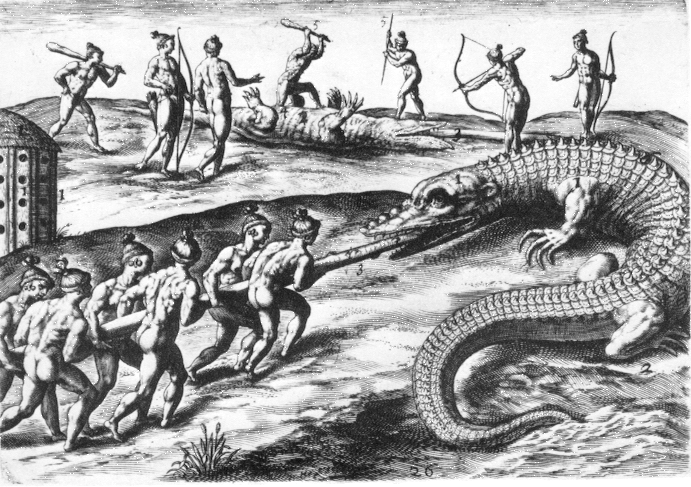
Alligators roamed the land.
-
Some of the pigs that the Spanish brought with them escaped into the woods. Wild pigs still live in the Florida woods today.
 |  |  |  |  |
|---|


America's REAL First Thanksgiving Teachers Manual
America's REAL First Thanksgiving, a pictorial resource book, was written for upper elementary to middle school students to highlight St. Augustine's important place in history. This teacher's guide can be used for simple to very challenging lessons. A Readers Theater brings the event to life while students reenact the events leading up to and including the first Thanksgiving meal. Suggestions for a banquet are included. Favorites such as vocabulary study, writing prompts, coloring pages, word searches, crossword puzzles, and creative thinking skill lessons are also included.
Extremely earnest about bringing attention to this seldom-explored historical topic.
~ School Library Journal
Robyn Gioia’s story gives us a delightful view of the first Thanksgiving, celebrated in Florida by Spaniards and Timucuans more than a half century before the one in Plimoth. Perhaps even more so than the later one, this event symbolized a new chapter in history, one well worth keeping in mind as we continue to ponder what it means to be an “American.”
~ Dr. John McGrath, Boston UniversityHistorian, History Channel Commentator
Gioia's book, geared to fourth grade through middle school, sets the scene for today's young explorers of history by presenting an overview of the world in the 1560s. . . Colorfully illustrated throughout, the pages of America's REAL First Thanksgiving take young readers on a comprehensive and fascinating historical journey, complete with Timeline, Glossary and References.
~ St. Augustine Record